
If you are working with the LEGO NXT kits, here is a parts list and a sorting guide to get you started.
Author: Eva the Robot
Educator • Author • Robot
Sorting the EV3 Kit
OK, kids! Here’s some information about the EV3 kits to get you started! Watch this video to see what’s in the box and how to sort and organize everything.
Now look at these PDFs on sorting the core set, getting to know the part names, and learning about the specifications.
Automation and Robotics
This is a semester long course in which students will “trace the history, development, and influence of automation and robotics as they learn about mechanical systems, energy transfer, machine automation, and computer control systems.” Students will then “use the VEX Robotics® platform to design, build, and program real-world objects such as traffic lights, toll booths, and robotic arms.”
- Unit 1 – Introduction to Automation and Robotics
- Unit 2 – Mechanical Systems
- Unit 3 – Automated Systems
Design and Modeling
This is a semester long course in which students will “discover the design process and develop an understanding of the influence of creativity and innovation in their lives.” Students will then be “challenged and empowered to use and apply what they’ve learned throughout the unit to design” a challenging independent project.
- Unit 1 – Introduction to the Design Process
- Unit 2 – Modeling and Statistical Analysis
- Unit 3 – Independent Design Challenge
More Fish Tales
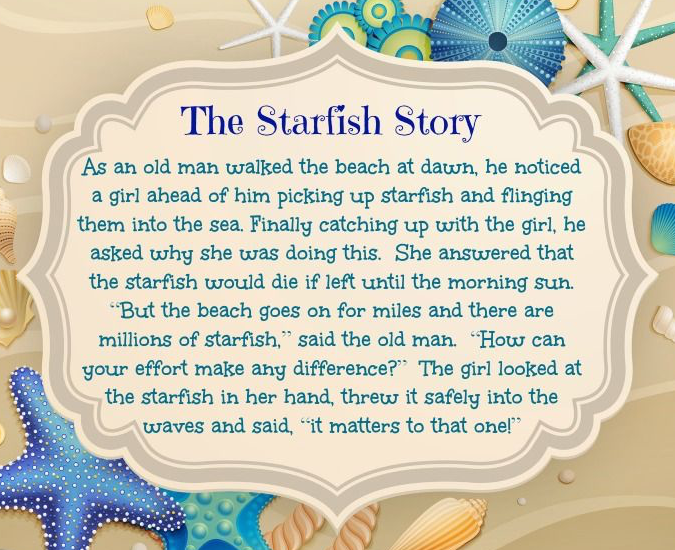
“How can your effort make any difference?”
I just wanted to share this short parable and allow it to speak for itself. What is my current takeaway? My students are my starfish. My effort makes a difference. So does theirs.
Teaching to Fish

Give a man a fish, and you feed him for a day. Teach a man to fish, and you feed him for a lifetime.
— Proverb
Most cultures and languages have a variation of the above proverb, but why? It addresses a tenet all humans as sentient beings across the world must come to understand. The passing of knowledge from one to another is part of who we are, how we come to grow and adapt, and essential to getting through life. It emphasizes that learning should be active and change behavior; the unengaged students who passively take what is given will never truly learn. My students and mentors (yes, teachers have teachers too) often discuss the proverb to remind ourselves of our purpose. Of how important our work is to ensuring others know what we have come to understand. And I often ponder my personal philosophy that I must teach what I know to others but be ready for them to teach me so much more. I am reminded of another quote which has similar cultural variations and addresses the acquisition of knowledge.
All I know is that I know nothing. — Socrates
This reminds me that even with as much knowledge as I gain, as many degrees and accolades I earn, it’s still only a tiny portion of what there is to know. But a recent concern of mine in my personal growth journey has been with trust and credibility. I feel some of what I’m trying to learn is being withheld from me for the purpose of scamming me or continuing to take advantage of me. My trust has been broken and I’m having a small existential crisis. So I’ve been searching for new mentors and building relationships with them – they must establish credibility while I must express my determination to meeting my goals. This has reminded me to consider that I must portray trust and credibility to my students in the same manner. How? By never giving fish, only teaching to fish.
Going Fishing
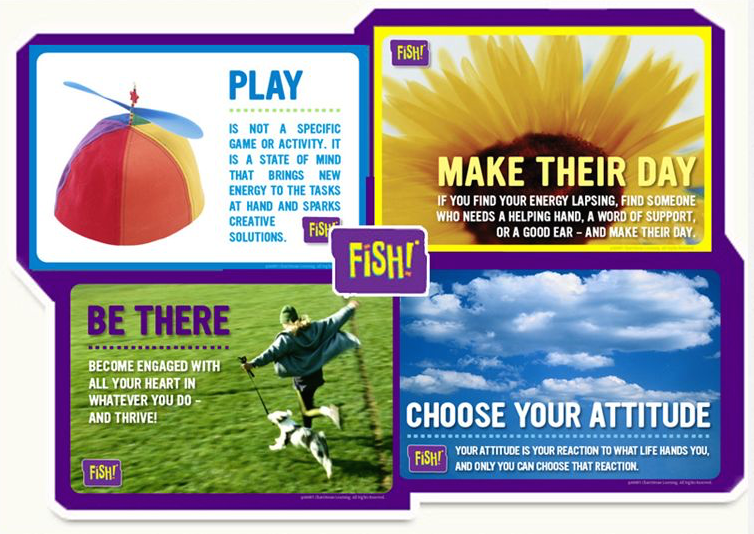
“There is always a choice about the way you do your work, even if there is not a choice about the work itself.”
School culture has become a hot topic in education during recent years because of the focus on proactive measures in behavior modification and effective learning strategies. Fish! is an organizational philosophy that I was introduced to years ago which I am revisiting with a different perspective – as a classroom teacher. My first introduction was as an employee, and my second reading was to prepare a professional development I gave to my school campus. This time there are a few concepts speaking to me more than others . . .
Adults spend a lot of our lives at work so we should consider what we want that to look like. Do we want to spend as much as 75% of our waking hours bored and feeling like time is dragging on? Or do we want to be engaged and stimulated by our tasks? More importantly, as a teacher leading the culture and climate of my classroom, I have to consider how my students want to spend their time as well as how I will help create memorable experiences. For example, can we make tedious and repetitious tasks less so?
Choose Your Attitude
Like the quote says, we may have no choice about the tasks we do, but we can choose how the work is completed. Yes, some students find lectures boring, but a simple change in how the information is delivered could be more engaging. I find similarities in how the fishmongers call out and repeat each other in the book describing the philosophy to some of the basic practices of the methodology called Whole Brain Teaching. Another similarity is the happy face/sad face menu created by the third floor staff to Whole Brain Teaching’s behavior scoreboard. But those are topics for another blog. Also mentioned were how people want to be creative and continue to learn and grow. As a teacher, it will be me who must lead by example in choosing my attitude each and every day.
Play
This is an easy one for middle school students! The tricky part is finding a way learn while we play as well as attend to our business with purpose. Can we do this while having fun? Luckily my students will have access to some of the coolest software and equipment available in education, so our work will often seem like playing.
Make Their Day
Effective learning is best achieved by creating memories. I see myself as less a teacher and more a facilitator of learning by developing and implementing engaging opportunities. Students have often commented on how animated I am while teaching, like acting or hosting a show. The idea is to bring the students into my crazy classroom and find ways to make it unforgettable. My excitement will be infectious to my students.
Be Present
Another focus in education is building relationships with students, and this ideally should happen with coworkers in any work environment. Being engaged with others and being there for them when they need us is essential to build those connections. We should always looking for the next opportunity to do so. But we must find balance and be present to ourselves too.
The Journey Begins

Welcome to my new journey into teaching middle school engineering, robotics, and prototype design. This blog was created to collect my thoughts and reflections through time. Please feel free to explore and comment on what you find.
A robot may not injure a human being, or, through inaction, allow a human being to come to harm. — Isaac Asimov
Explore Engineering
In 6th grade, we will explore various engineering careers including:
- computer engineering
- electrical engineering
- mechanical engineering
- civil engineering
- aerospace engineering
- biomedial engineering
- sound engineering
I’m In The Zone
What are three big “A-Ha’s” that you had watching this video?
- Falcon has a unique, yet long history which I need to be aware of to be part of the vision of the future
- because of innovations in technology, many new learning methods exist and must be utilized to prepare our students for jobs that do not yet exist
- the phrase “engaging environments” in the video stood out to me because this is exactly my vision for my own classroom – it’s the students who should be doing most of the work with myself serving as a facilitator
What is one key takeaway you have related to where Falcon Zone has been and where it is going that applies to your classroom?
- It is so refreshing to learn that I am not the only one realizing education is going through a major paradigm shift in how everything works. Gone are the days of passive learning. Students must be self-aware of their own strengths and weaknesses and how they contribute to them being the best learners they can be.
 My STEM Journey